
THE ODYSSEY: THE STORY OF ODYSSEUS IN THE ANCIENT WORLD & BEYOND

Odysseus (also known as Ulysses in Latin) was one of the Greek heroes who sailed to Troy to take part in the Trojan War. Unlike some of the other warriors who fought at Troy, he was known for his intelligence and cunning in solving problems.
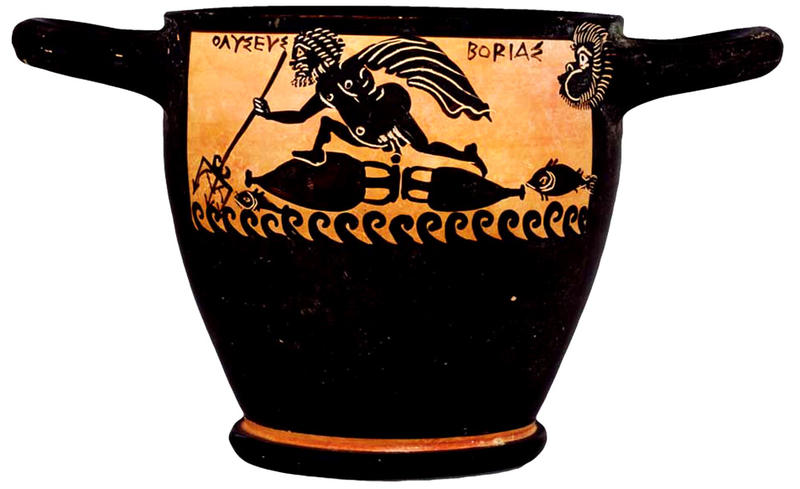
Boeotian black-figure skyphos (drinking cup) depicting Odysseus at sea. AN1896-1908.G.249. On display in the Ashmolean's Greek World Gallery
The Odyssey is an epic poem attributed to Homer, composed in the 8th century BCE. It tells the story of Odysseus’ return home from Troy to the island of Ithaca, where he was king. In Antiquity, many stories about Odysseus circulated, not all of which are told in the Odyssey. One of the principal ways in which these stories were told was through images.
After ten years of siege warfare, the Greeks realised that the city of Troy would not fall by force alone. Two objects carved in the Roman period show how Odysseus solved the problem. The first obstacle was a prophecy that Troy would be safe as long as the cult statue of Athena, its patron deity, remained within its walls. Odysseus, with another hero, Diomedes, crept into Troy to steal the statue, also known as the Palladion (or Palladium).
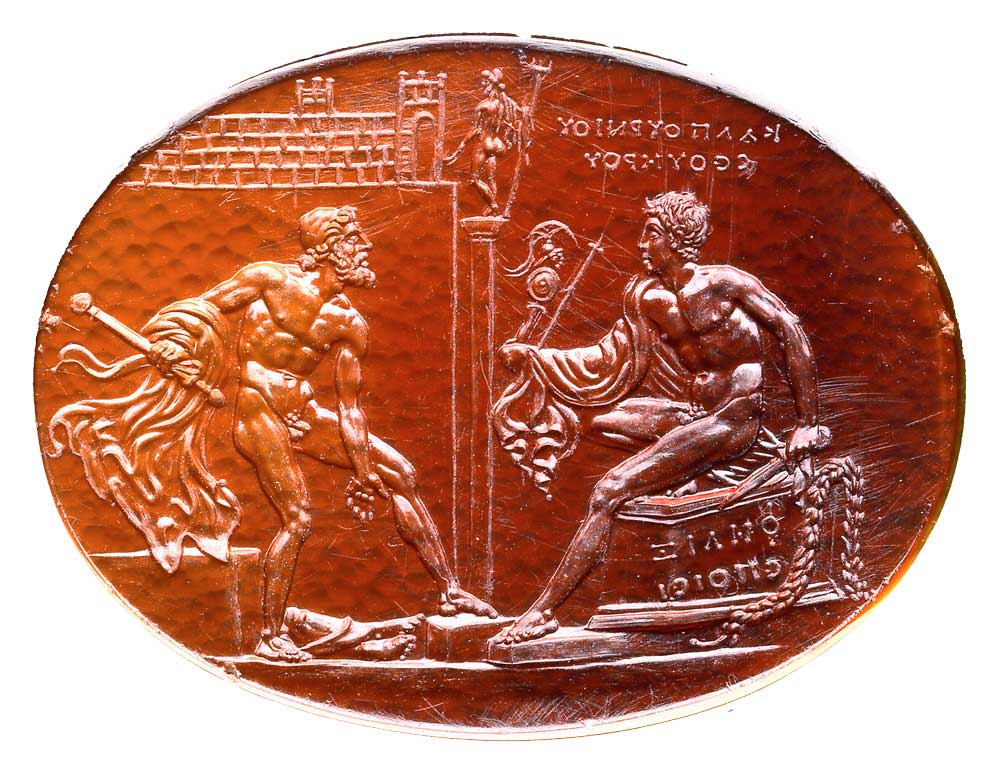
The Felix Gem, one of the finest seal-stones to survive from the Roman period, depicts Diomedes holding the Palladion, accompanied by a bearded Odysseus wearing a characteristic woollen cap. After that, all that remained was to infiltrate Greek warriors into the besieged city.
Odysseus’ plan was to build a wooden horse which appeared to be a parting gift from the Greeks as they sailed away, but in fact contained the heroes who would finally conquer the city once it was brought inside the walls.
The Trojan Horse appears on the left side of this sarcophagus lid, being dragged into Troy by the unsuspecting inhabitants. It is echoed on the right-hand side by horses of the Greek hero Achilles, who is dragging the body of Hector, prince of Troy, behind his chariot.

Sarcophagus lid with scenes from the Trojan War, 200–300 CE. ANMichaelis.111. On display in the Ashmolean's Rome Gallery
Once Troy had fallen, Odysseus set sail with his men for home. Along the way he had a number of adventures which delayed his return by another ten years. This tale forms the basis of the Odyssey, which covers the time period of Odysseus’ final return to Ithaca, by which time he has lost all of his men and ships. The Odyssey is a complex narrative which includes a kind of flashback to these earlier events, as Odysseus tells his story to King Alcinous, who helps him along the way.
One of his most famous encounters was with the gigantic one-eyed Cyclops Polyphemus. Odysseus and his men find his cave well stocked with milk and cheese, because Polyphemus was a shepherd. Unfortunately, as they discover, he also has a taste for human flesh because he kills and eats two of Odysseus’ men instead of offering his visitors hospitality.
Finding himself trapped in the cave, because Polyphemus covers its entrance with a huge boulder every night to keep his sheep in, Odysseus comes up with a plan to blind the Cyclops with a wooden stake and then escape by clinging to the belly of his prized ram.
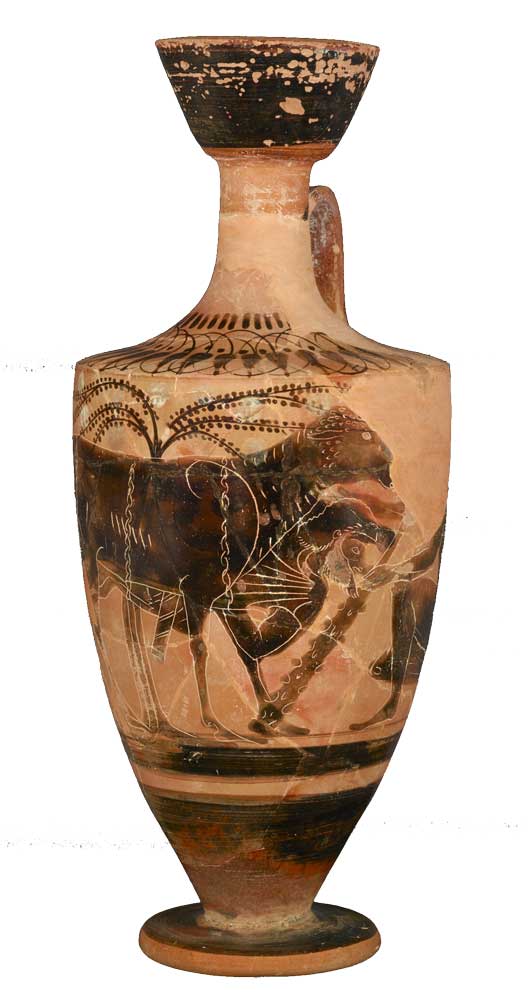
Attic black-figure pottery lekythos depicting Odysseus clinging on to a ram, 500–490 BCE. AN1934.249. On display in the Ashmolean's Greek World Gallery.
This lekythos (perfumed-oil jar) above shows the moment of Odysseus’ escape as the Cyclops lets his sheep out in the morning. Polyphemus’ reaction is to pray to his father, Poseidon, for vengeance, making Odysseus’ return much harder.
After the Cyclops, Odysseus and his crew land on the island of the goddess Circe. She is weaving at her loom when some of Odysseus’ shipmates find her palace. Unlike Polyphemus, she offers them hospitality, but in the form of drugged wine, which turns them into pigs. Meanwhile, Odysseus has been warned by another god, Hermes, to eat a particular plant as an antidote to the poison.
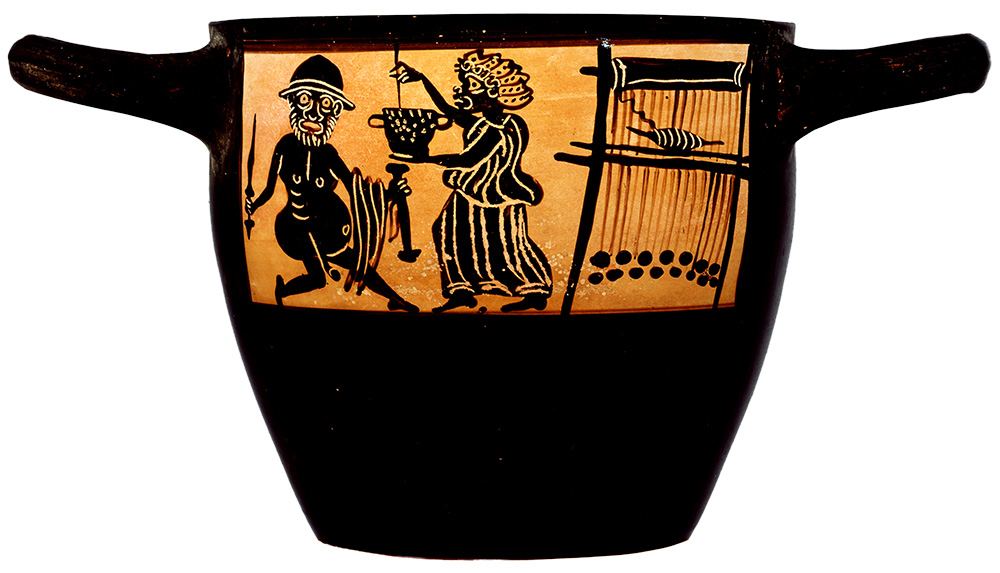
Boeotian black-figure skyphos depicting Odysseus and Circe, 400–300 BCE. AN1896-1908.G.249. On display in the Ashmolean's Greek World Gallery
A cup in the Ashmolean collection (above) shows the moment Circe offers him the potion, and instead of turning into an animal, he draws his sword ready to kill her. She begs for forgiveness and promises to return his men to him in their original form. They spend a year at the palace, eating and drinking, before moving on.
This cup is notable for depicting Circe as a black African woman, perhaps emphasising the far-flung nature of Odysseus’ travels. On the other side, Odysseus is shown riding an improbable raft made of wine storage vessels (amphoras), being blown along by the North Wind (Borias). This cup was seemingly made for someone being initiated into a mystery cult at Kabeirion near Thebes. The subject of drinking wine, perhaps mixed with other intoxicating substances, could give a clue to the nature of the initiation.
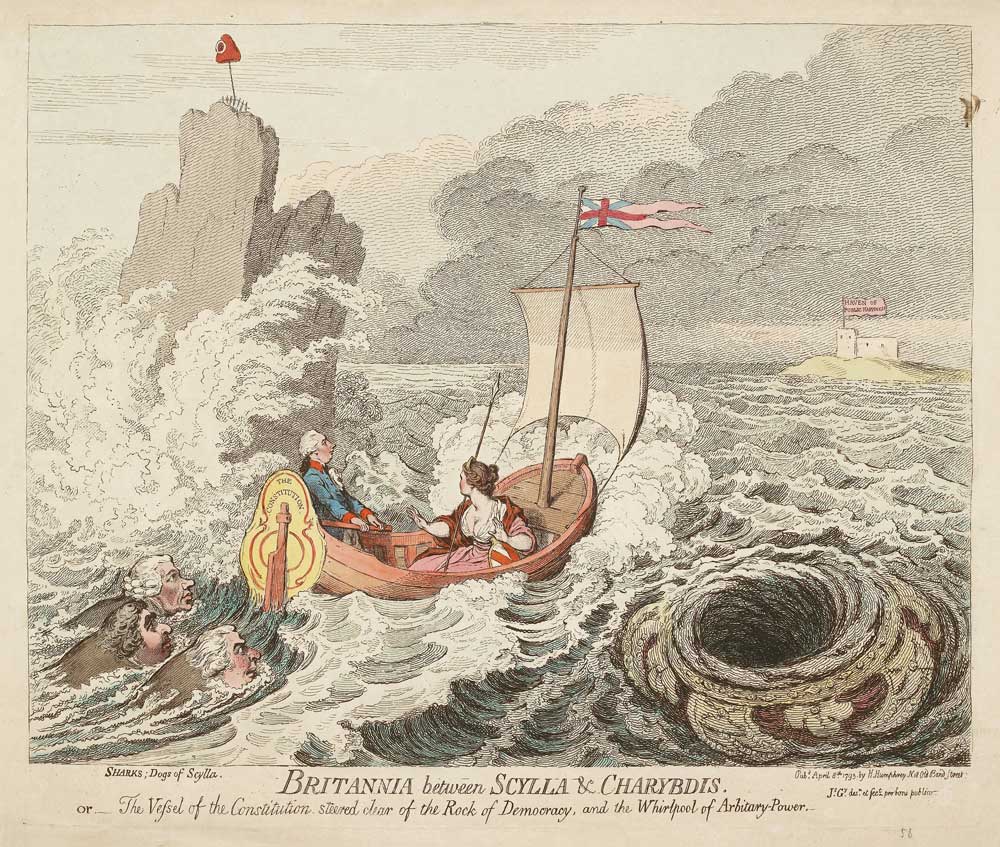
Print showing Britannia between Scylla and Charybdis by James Gillray, 1793. WA2003.Douce.2768
The Odyssey has inspired artists for thousands of years, as two further objects in the Ashmolean collection show. The first is an 18th-century caricature depicting Scylla and Charybdis, the monster that grabs passing sailors and the whirlpool that sucks ships down into the depths. This has become a metaphor for a dilemma. Here the prime minister of the day, William Pitt the Younger, is steering his passenger Britannia on a course between democracy and arbitrary power.
Another artist inspired by the Odyssey was Constance Phillott (1842–1931). She became active in the women’s suffrage movement, signing the first petition to grant women the right to vote in 1866.
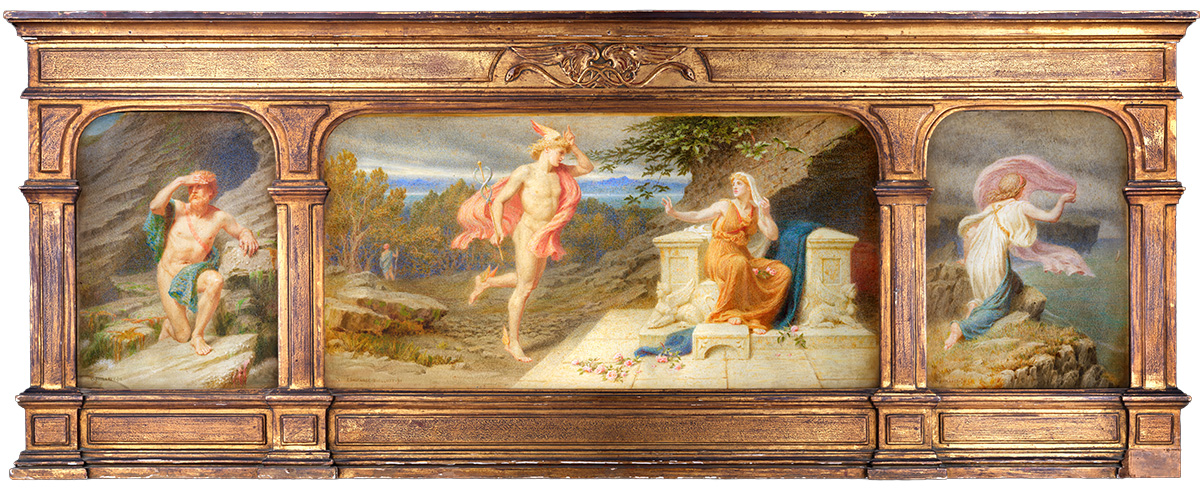
Triptych showing Calypso, Hermes and Odysseus by Constance Phillott, 1911. WA1995.196.1-3
Her main subject on this triptych above is the nymph Calypso, with whom Odysseus lives for seven years in idle luxury. She chooses to focus on the moment Hermes is persuading Calypso to let Odysseus go back on his travels and return home; Odysseus is shown on one side, and Calypso’s farewell is seen on the other.
Odysseus does finally return home to Ithaca, disguised as a beggar. His palace is now occupied by suitors, who are trying to persuade his wife and queen Penelope to marry them. By now Odysseus had been gone for 20 years, and many presumed him dead. As he approaches the palace, his faithful dog Argos recognises him. Argos has been left to live on a rubbish heap but wags his tail when he sees his former companion return, then dies peacefully.
This provided an appropriate scene for a medal issued by the Canine Defence League (now Dogs Trust) to recognise those who have devoted their lives to the interests of dogs.
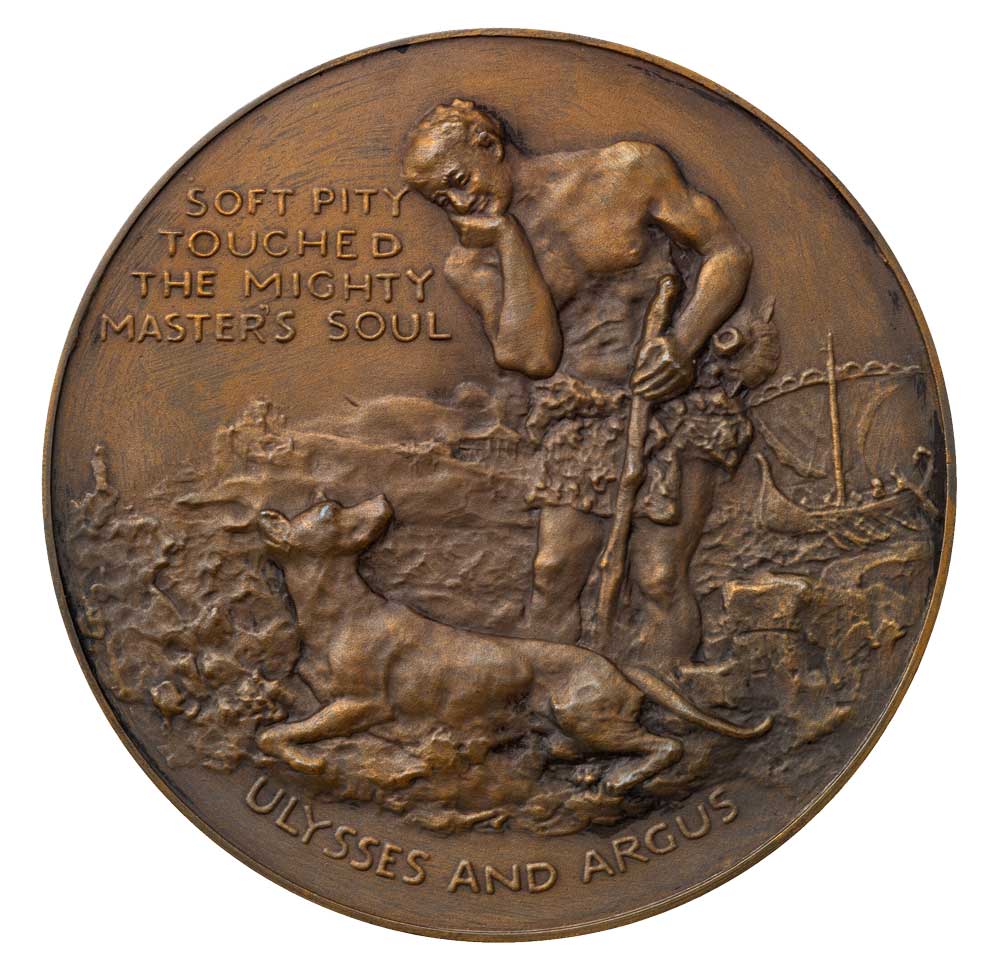
The Argus Medal of The National Canine Defence League, engraved by Frank Bowcher, 1891. HCR5609
The Odyssey and its companion poem, the Iliad, are dated to the 8th century BCE (the end of the Iron Age), but both clearly have much earlier roots. This has fuelled the debate over whether the poems were written by a single person (Homer) or by multiple individuals. Two particular episodes point back to an origin in oral poetry that circulated perhaps 3,500 years ago, in the Bronze Age.
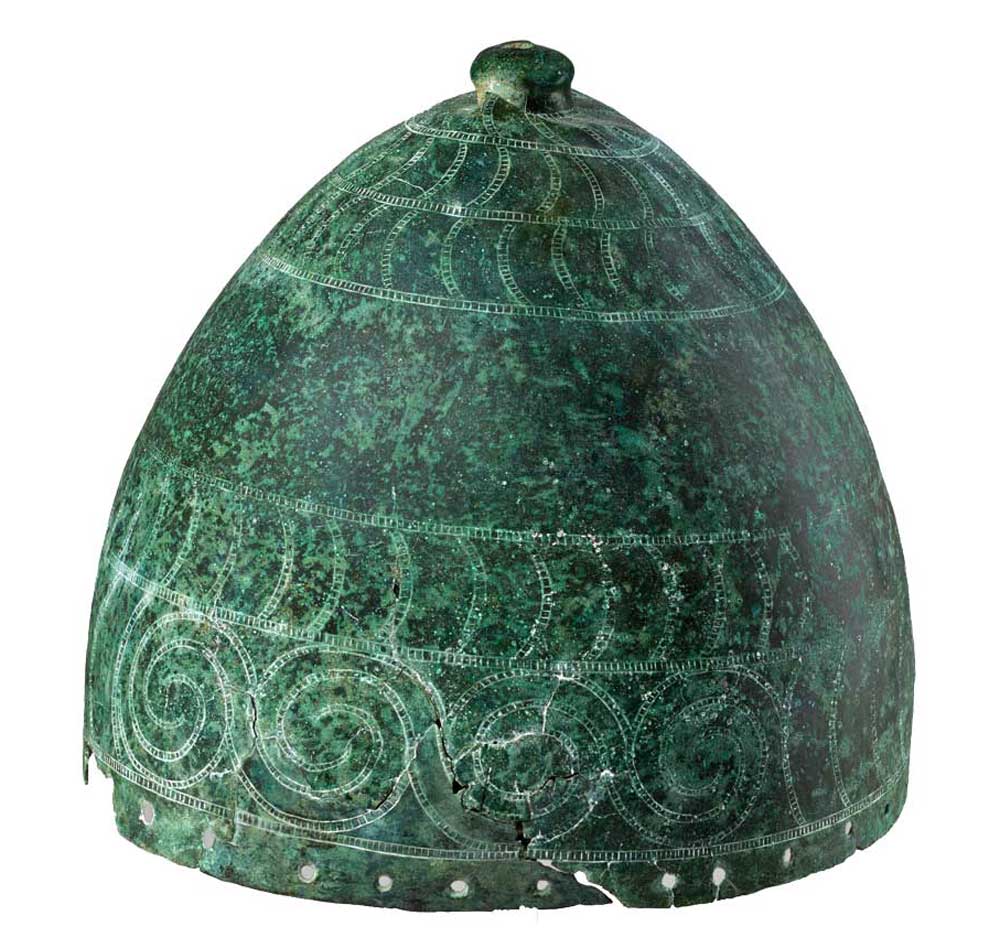
Bronze helmet decorated with punched bands of stylised boars' tusks and spirals, 1400–1300 BCE. AN2015.5. On display in the Ashmolean's Aegean Gallery
The first occurs in the Iliad, which recounts part of the Trojan War. Odysseus is given a helmet described as made of boar’s tusks stitched onto a leather cap. Such helmets have been found in Bronze Age graves but were unknown in Homer's time. The boar’s tusks would have been hunting trophies, and hunting boar would have been useful training for war; Odysseus has a scar from boar hunting which finally proves his identity to those who know him on his return to Ithaca.
On display in the Ashmolean's Aegean World Gallery is a bronze helmet whose decoration imitates boar’s tusks. In the Iliad and the Odyssey, bronze is the material used for armour and weapons, not iron, again pointing to an origin in the Bronze Age for some of the poetry.
Poems would have been passed down from poet to poet, each making their own changes, until the words were finally written down centuries later in the Iron Age. By this time, some aspects of the poetry would have seemed archaic, or perhaps even difficult to understand.
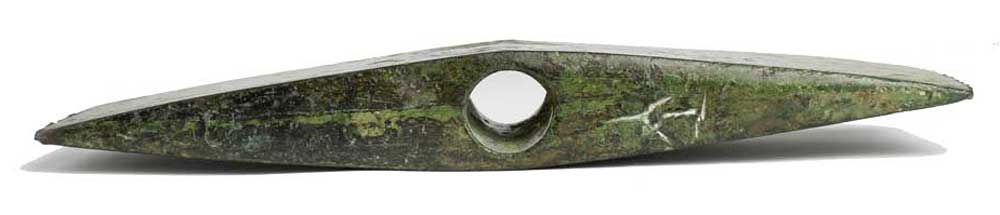
Bronze double axe with inscription, 1600–1450 BCE. AN1896-1908.AE.85
One example of this confusion comes towards the end of the Odyssey, when Penelope finally sets a challenge to the suitors to claim her hand in marriage. Anyone who can string Odysseus’ great bow and fire an arrow through 12 axes will marry her.
Translators have often struggled with the details of this challenge, since it is unclear how an arrow can pass through 12 axe heads. It becomes obvious when considering the double axe heads used in the Bronze Age: these had a circular hole in the middle, and 12 set up in a row would have posed a difficult but not impossible target.
And so, once all of the suitors have failed in turn, the mysterious beggar in their midst meets the challenge. Odysseus then turns the bow on the suitors and massacres them, before a tearful reunion with Penelope. It is the brutal last act in a poem about a complicated hero, a great fighter but also a clever strategist, a fearless adventurer who wants nothing more than to return home.
Versions of this story have been circulating for at least 3,000 years, in words and images, with each generation making Odysseus and the Odyssey their own.