
SHOUT OUT FOR WOMEN


WOMEN'S STORIES
Women sharpening agricultural tools hanging scroll by Fang Rending, 1949–1975
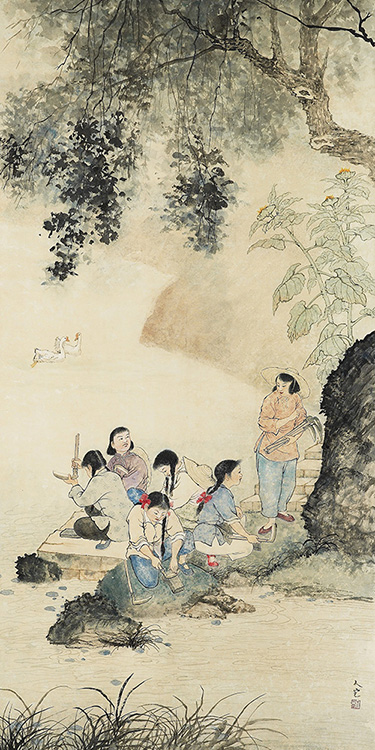
This finely executed painting mounted on a hanging scroll depicts a group of women sharpening agricultural tools in a peaceful pastoral scene. During China's Communist revolution, women’s contributions to manual labour were greatly emphasised. Their red accessories underscore the role these labouring women are supposed to play in the transformation of society, and their depiction stands in stark contrast to traditional representation of women as delicate, indeed fragile.
The artist Fang Rending was born in Zhongshan County in Guangdong province. He studied under the founder of the Lingnan school Gao Jianfu (1879–1951), and between 1929 and 1935 he, like Gao, studied in Japan.
An important innovator in Chinese figure painting, Fang was greatly affected by the hardships of ordinary people and focussed on depicting labourers in rich, realistic detail. His style and subjects therefore adapted easily to the romantic realism of Communist China after 1949.
EA2007.166
Not on display
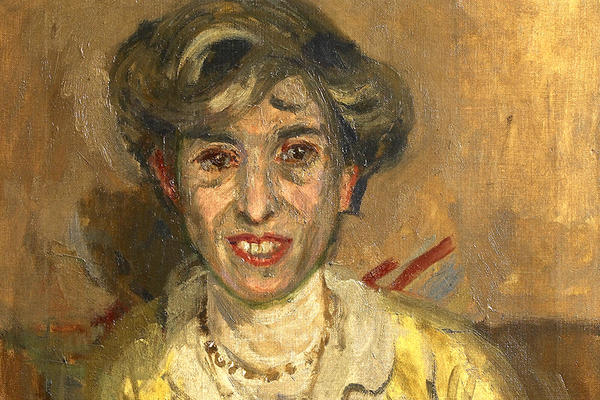
The Convalescent by Gwen John (c. 1919–1926)
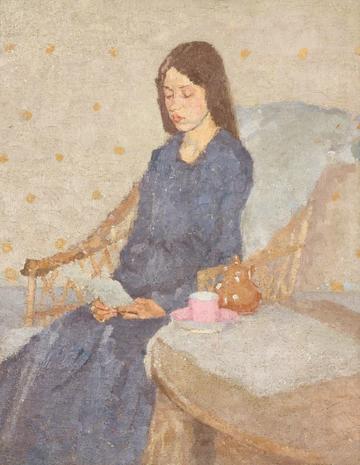
Gwen John was one of the greatest artists of the 20th century, but has been often overshadowed by her more famous brother Augustus.
Born in Wales, Gwen studied at the Slade School of Art in the 1890s. She settled in France in 1904, living first in Paris and then in Meudon.
She worked intensely, independently, and very slowly. Her pictures often show interiors or landscapes with solitary female figures, like this painting of a still, rather solemn young woman sitting in a wicker chair reading. The sitter’s identity is unknown, but the portrait was done in the artist’s studio in Meudon.
John was a methodical, serious painter with a deep interest in colour theory and tone. Her paintings, like this one, are characterised by a chalky impasto and a carefully arranged tonal palette, which shows the influence of James McNeill Whistler on John, who was briefly his pupil.
WA2019.5
On display
'Under the spell' of Wuthering Heights
Edna Clarke Hall, A Young Couple Parting c. 1900–1903
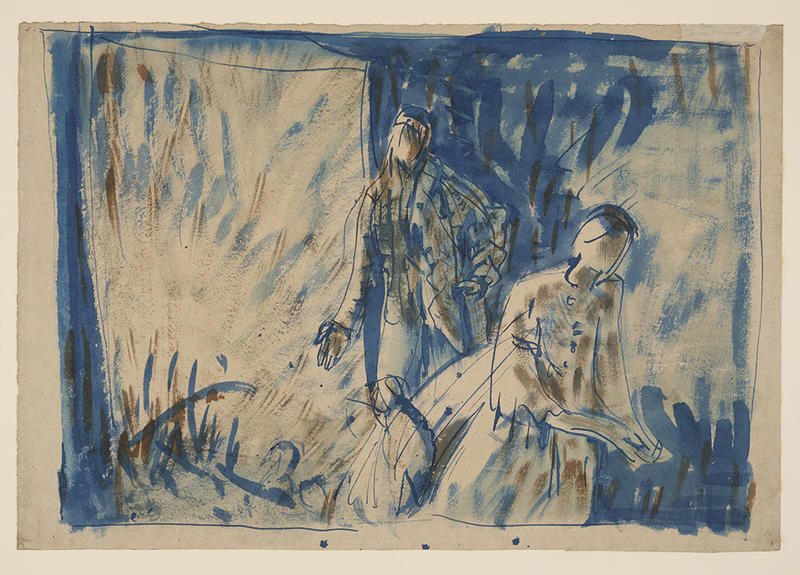
This intimate drawing in pen and blue ink is by the 19th-century artist Edna Clarke Hall, and is inspired by Emily Brontë’s 1847 novel Wuthering Heights.
Edna Clarke Hall was described as the ‘star of her generation’ while a student at the prestigious Slade School of Art in the 1890s. But at just 19 years old, she entered into an unhappy marriage, and her creative ambitions were constrained.
Clarke Hall first read Wuthering Heights around the time of her marriage and became obsessed with it. When she and her husband moved to a medieval timber-framed house in Upminster, she used the big-beamed interiors as the setting for the works she made inspired by Bronte’s novel.
In the artwork above, the protagonists Cathy and Heathcliff stand close to a large open hearth – presumably the ‘huge fire-place’ in the sitting-room of Wuthering Heights, the eponymous house in Brontë’s novel. The female figure is moving away from a male figure, they are parting company. Troubled by her own difficult marriage, the artist returned time and again to the tragic story of the ill-fated lovers Catherine Earnshaw and Heathcliff.
Over a period of 30 years, she made hundreds of sketches, watercolours, and etchings based on the novel. She wrote in her autobiography that she ‘lived’ the characters of both Cathy and Heathcliff, working on the drawings as if she were ‘under a spell’.
You can order the new edition of Wuthering Heights featuring illustrations by Edna Clarke Hall, with an introduction by Dr Eliza Goodpasture, Research Fellow at the Ashmolean Museum, here.
WA1941.70.1
View on request in the Western Art Print Room
Julia Margaret Cameron's intimate photographs, 1867 & 1869
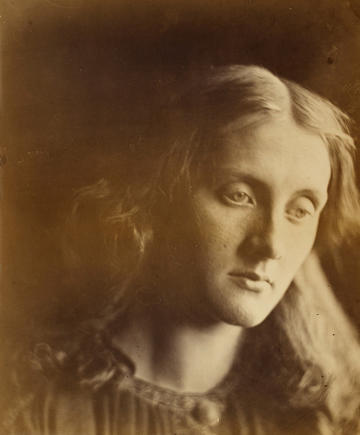
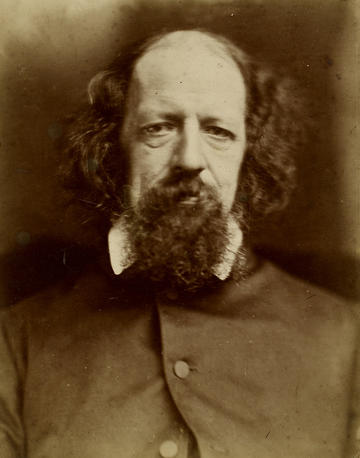
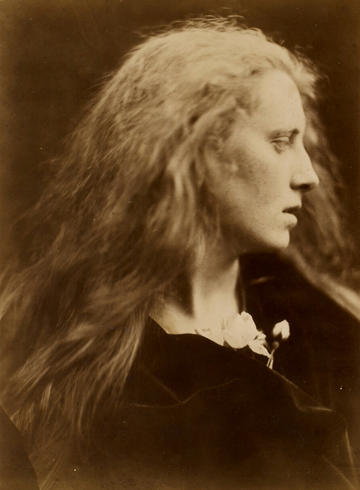
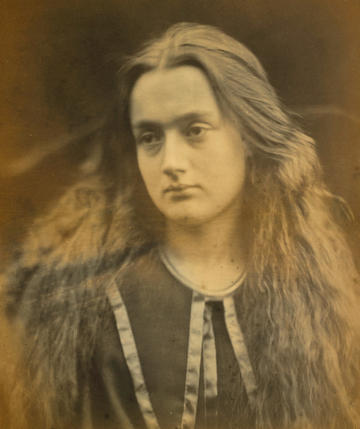
Left to right: 'My Favourite Picture of all My Works' (Julia Jackson); Sir Alfred Tennyson; Mary Pinnock as Ophelia; all 1867. Far right: My Ewen's Bride ('Annie Chinery') 1869. By Julia Margaret Cameron © Ashmolean Museum
Julia Margaret Cameron was an early pioneer of British photography and well known for her soft-focused portraits. She was greatly admired by the Pre-Raphaelites.
Her photographs were rule-breaking: purposely out of focus, and often including scratches and smudges. She also posed her sitters as characters from biblical, historical or allegorical stories.
Cameron was born in Calcutta in 1815. But she only started taking photographs in her 40s, after moving to England in 1845. She made her home in Freshwater on the Isle of Wight.
Early in 1866, Cameron moved into a highly creative period with the camera. She started to take a new direction as her children had all left home, moving closer in to the subject.
Her photographic career, however, was very short. She only worked for 11 years, but she created over 1,000 photographs of many famous people and family friends.
Lena Fritsch, the Ashmolean's Modern and Contemporary Art Curator, reflects:
'She creates these really dreamy images and the soft focus photographs of women link to her concept of beauty which is a very Victorian, English concept of beauty, at the time. A Christian concept, also inspired by classic mythology.
'And the sitters are interesting. She has all these different people in front of her lens. Photographs of Julia Jackson (above left) are in the Ashmolean collection, who was Virginia Woolf's mother. Very beautiful photographs of her.
‘But then all these different important men. John Herschel; the dramatist Henry Taylor; Charles Darwin was photographed by her.'
WA.OA1348 & WA.OA1352
Julia Margaret Cameron & her contemporaries
View on request in the Western Art Print Room
Hangaku-jo, the female samurai warrior, Utagawa Kuniyoshi, c. 1832
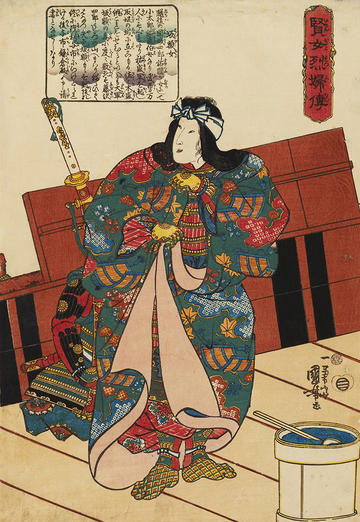
Hangaku-jo Gozen was a celebrated female samurai who lived in the province of Echigo (present-day Niigata) in the late 1100s.
In 1201 she joined her uncle and cousin to fight – unsuccessfully – against the ruling Kamakura shogunate in the Kennin Rebellion, playing an important role in the defense of their operations at Torisaka Castle. She is said to have led 3,000 soldiers against an army of 10,000 to defend the castle.
She was well known for her bow and arrow skills and the 13th-century chronicle Azuma Kagami described her as ‘standing at the top of the watchtower with her hair tied up like a child and wearing haramaki armour, and none that were shot by her arrows survived.’
During the battle she is said to have hurled huge planks of wood at her enemies, and you can see these behind her in this print, with the armour just visible in front of them.
This striking illustration of Hangaku-jo is by the famous Japanese designer Utagawa Kuniyoshi from his series of Lives of Wise and Heroic Women.
EA1983.82
Not on display
Angelica Kauffman, the female gaze, 1770s
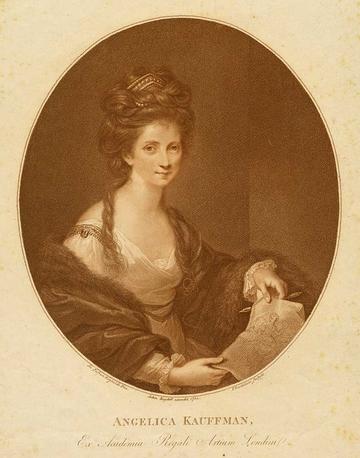
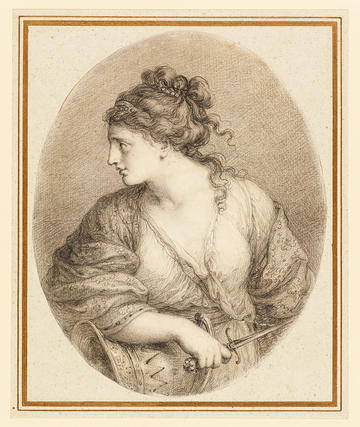
Left: Portrait of Angelica Kauffman, Francesco Bartolozzi after Sir Joshua Reynolds, 1780. Right: The Tragic Muse (black chalk), Angelica Kauffman, 1770–1782 © Ashmolean Museum
Angelica Kauffman (1741–1807) was a star of the art world in the 18th century. The Swiss-born painter was prodigiously talented, having been trained by her artist father in Italy. She moved to London in 1766 and became a founding member of the Royal Academy in 1768, one of only two women members with Mary Moser (1774–1819).
In London she established a reputation as one of the outstanding contemporary painters in Europe, and became an ally with Sir Joshua Reynolds in the advocacy of history painting and the 'Grand Style'. Her home in Golden Square in Soho was a celebrated meeting place for artists, musicians and wealthy sitters.
Kauffman's paintings emphasised the female experience, which was radical for the time.
WAHP43641 & WA1955.15
View on request in the Western Art Print Room
Clara Peeters, Still Life of Fruit and Flowers, 1612–1613
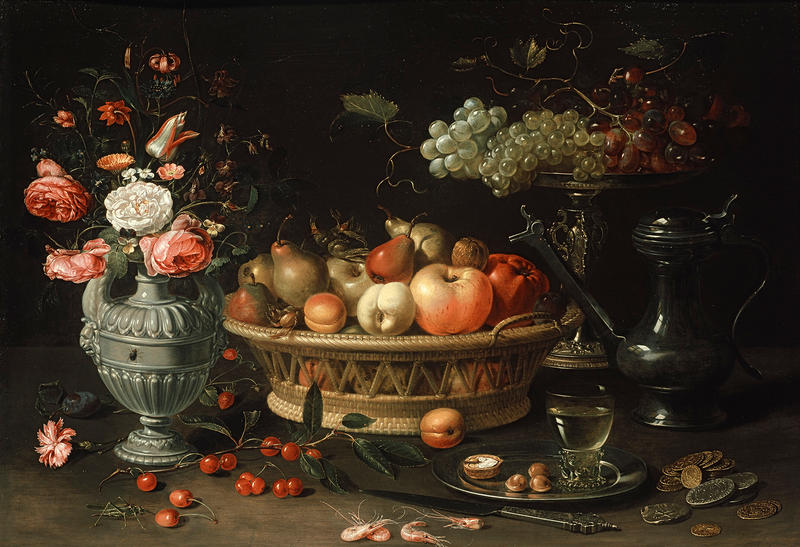
Although little is known about her life, Clara Peeters is thought to have been one of the first professional women artists of the Dutch Golden Age and early modern Europe.
This elaborate still-life, at 64cm wide x 89cm high, is one of her largest paintings and shows a table richly laden with fruit, flowers, nuts and shrimp. It’s executed in oil on copper. Copper was a popular choice for artists at the time because it lends itself particularly well to finely detailed brushwork and is a non-absorbent surface.
The coins you see on the right of the painting helped to date the work to after 1609, while the silver wedding knife appears in five of her other paintings.
It's a highly skilful work and is part of one of the most comprehensive collections of 17th-century Dutch and Flemish still-life paintings in the world. The collection was put together by Theodore Ward and his wife Daisy Linda Ward (1883–1937), a painter from New Jersey, who bequeathed the collection to the Ashmolean.
WA1940.2.61
On display
Ariadne, an unsung ancient Greek heroine...
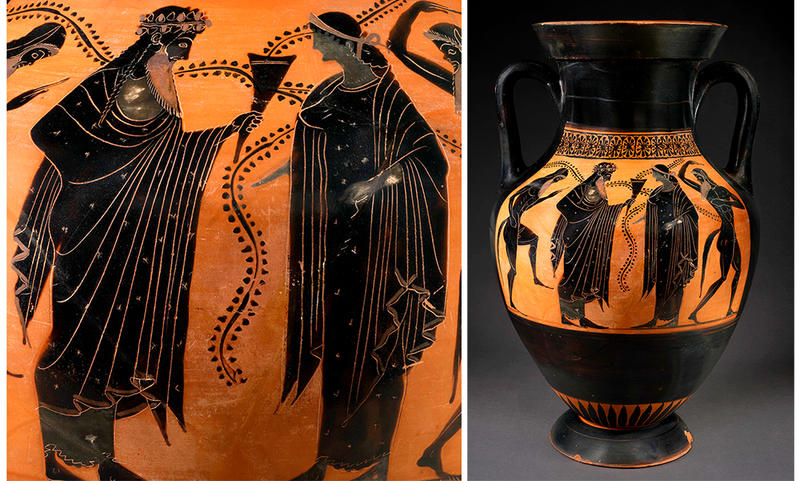
In Greek myth, the Cretan princess Ariadne is an unfortunate figure, although perhaps an unsung heroine.
Firstly, she betrays her family in order to help the hero Theseus kill her half-brother, Asterion the Minotaur, who's hiding in the depths of the Labyrinth.

In most versions of the myth, Ariadne gives Theseus a ball of thread, often said to be red, to help him retrace his steps and escape the Labyrinth.
Then, her reward is to be betrayed in turn, when Theseus abandons her on the island of Naxos. Her fortunes, however, improve when the wine-god Dionysus finds her and they fall in love.
The vase (above) was painted around 530–520 BCE and shows Ariadne as the consort of Dionysus. She is very rarely shown with Theseus in Greek depictions. Vase painters tended to repeat the same scenes: Theseus kills the Minotaur and Ariadne drinks wine with Dionysus.
Although there are no recognisable depictions of Ariadne from this period, there are a number of colourful frescoes showing women in elaborately woven and embroidered clothing.
AN1911.256
Not on display