

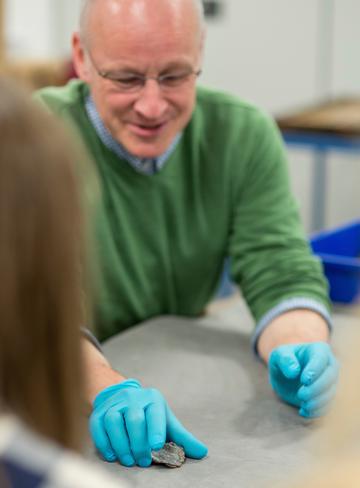
JIM HARRIS
Teaching Curator
Contact
Email: jim.harris@ashmus.ox.ac.uk
Academia edu: Jim Harris
ORCID: 0000-0002-6792-0384
The Teaching Curator blog
University of Oxford webpages
Biography
Jim Harris is the Museum's Teaching Curator, leading the Ashmolean's academic engagement programmes across the curriculum of the University of Oxford, a post originally established by a grant from the Andrew W Mellon Foundation and now generously supported by the Barrie A and Deedee Wigmore Foundation.
Jim trained as an actor at the Royal Academy of Dramatic Art and as an art historian at the Courtauld Institute of Art, where he wrote his PhD thesis on the polychrome sculpture of Donatello, under the supervision of Professor Patricia Rubin. He subsequently held the Courtauld's Andrew W Mellon Research Forum Postdoctoral Fellowship and the Caroline Villers Research Fellowship in Conservation.
His research employs the technical examination of sculptural materials and surfaces, alongside archival work, to investigate issues of artistic and patronal intention and the shifting meanings of objects.
In 2012, Jim came to Oxford as part of the Mellon-funded University Engagement Programme, where he took on responsibility for exploring the use of the Ashmolean’s collections in university pedagogy; devising and delivering teaching across a wide range of disciplines; and training faculty and early-career researchers to deploy objects and images in developing a more diverse, equitable and inclusive teaching practice.
He is also responsible for the Ashmolean Faculty Fellows programme, which offers Oxford faculty the opportunity to work in the Museum to develop new, collections-based teaching and plays a leading role in the Ashmolean's strategy for Public Engagement with Research, particularly in relation to early-career scholars. He has curated collaborative exhibitions and gallery interventions at the Ashmolean with Mathematicians, Historians, Linguists and contemporary artists, and has received two Teaching Excellence Awards from the University, as well as a Humanities Division Teaching Project Grant for the Krasis programme. He has published on object-based teaching and spoken widely on the subject in the UK, Europe and North America.
In 2025, Jim and a team of colleagues in neuroscience, psychiatry, history and theology received the Vice Chancellor's Award for Teaching and Learning, in recognition of Diversity in Death and Dying, a part of the medical curriculum which uses the Ashmolean's collections to focus discussion on issues raised by end-of-life care, palliation, chronic degenerative disease and the role of the medical professional in relation to their patients and their families and communities. Jim is a member of the University's Medical Humanities Steering Committee, which received the Vice Chancellor's Award for Research Culture, also in 2025.
In 2021, Jim was elected a Research Fellow of Somerville College, in recognition of his contribution to the teaching life of the college and the university and to the work of the Somerville Medieval Research Group.
In other lives, Jim trained and worked extensively as an actor and musician, was a director of the contemporary gallery Man & Eve and is Chair of Trustees of the educational charity Our Hut, which teaches on architecture and the built environment in inner-London schools and communities. He is a regular broadcaster on BBC Radio 2, a Licensed Lay Minister in the Church of England, and sits on the Heritage and Collections Committee of the Marylebone Cricket Club.
Jim is an art historian, focusing on the sculpture of late-medieval and early-Renaissance Europe. My primary interests lie in sculptural materials and techniques, and especially in the question of how three-dimensional surfaces are transformed by polychromy, the addition of paint, gold and inlays, and by the subsequent, successive alterations, deliberate or by chance, that they undergo during their lifetimes. These serial transformations can inform our understanding of an artist’s intentions and workshop practice, of an object’s physical history and of changes in its function and meaning, as well as touching on wider issues of taste, aesthetics, belief and reception.
Similar questions raised by the making, function and meaning of objects (and words), have driven my research into other topics, for example the extraordinary, monochrome Passion Cycle painted for the Benedictine house of San Nicolò del Boschetto in Genoa, the language of Ghiberti’s 'Commentarii' and drawings made by sculptors. He continues to research, publish and speak on these and other aspects of his specialism.
Since arriving at the Ashmolean, detailed attention to object and text has remained at the heart of his work, as he has focused on understanding and exploiting museum collections as tools in university teaching.
It is his position that the object-centred classroom offers a democratic, inclusive and equitable alternative to more traditionally hierarchical spaces for teaching and learning. In the face of the fundamental question, 'What do you see?', no member of a group speaks with more privilege than another: to experience an object together and to build an agreed, shared understanding of it is a work of knowledge-creation and knowledge-exchange to which every student can contribute and in which every student is heard and valued. In a culturally and socially diverse student body, therefore, the Museum represents an equally and uniquely diverse resource for drawing out otherwise disregarded or less-audible voices.
As far as the collections themselves are concerned, he is interested in the capacities or affordances of objects and in particular three things: their value in developing transferable skills derived from detailed, attentive examination; their capacity to act as primary sources, starting points for research and investigation in disparate and unexpected disciplines; and their usefulness to faculty and early-career researchers in pursuing accessible, alternative learning strategies, complementary to textual studies.
These capacities are independent of any direct thematic, functional or historical connection between the object and the discipline under consideration but, rather, are reliant on the object’s inherent quality of ‘agility’ - its potential to submit to interrogation from and to speak into any number of disciplinary standpoints. Teaching faculty and early-career scholars to work with objects in order to better exploit the potential of museum collections has come to form a significant part of his work, as articulated in his 2017 article for the Journal of Museum Education, ‘Agile Objects’, co-authored with archaeologist and former Teaching Curator, Dr Senta German, and described in more recent work published in collaboration with colleagues from Medical Sciences.
Undergraduate Teaching
- Collaborative, object-based classes and courses, devised and delivered in the following Oxford BA degree disciplines:
- Ancient History, Ancient Middle Eastern Studies, Classical Archaeology and Ancient History, Classics, English Language and Literature, French, Geography, German, History, History of Art, Italian, Medicine
Graduate Teaching
- Collaborative, object-based classes and courses, devised and delivered in the following Oxford Masters degree disciplines:
- MBA, MSc Criminology, MSc Migration Studies, MSt Archaeological Science, MSt English, MSt German, MSt History, MSt History of Art and Visual Culture, MA History of Design, MSt Politics, MSt Theology, MSt Women's, Gender and Queer Studies, Medicine (Clinical) Year 5 Speciality, Neuroscience and Psychiatry
Undergraduate Supervison
- Dissertations in English and History of Art
Graduate Supervision
- MSt Dissertations in English, History, Medieval Studies
Graduate Training
- Eloquent Things: Object-teaching course delivered as part of the Doctoral Training Programmes of the Humanities and Social Sciences Divisions of the University; 2 iterations per term, 8 doctoral candidates, postdocs and faculty members per course, 2016-present. See https://www.socsci.ox.ac.uk/event/eloquent-things-teaching-using-real-ob...
- Krasis: competitive entry, cross-disciplinary programme offering teaching and learning in a museum context for 8 Early Career Researchers and 16 undergraduates/taught postgraduates per term; 2018-present. See https://www.ashmolean.org/krasis-blog
International Teaching/Lecturing
- Royal Danish Academy of Sciences and Letters, Copenhagen (2010)
- Simon Fraser University, Vancouver (2013)
- Yale University (2014, 2024)
- University of Wyoming (2014, 2016, 2017, 2019)
- Institute of Fine Arts, New York University) (2015)
- University of Pennsylvania (2016)
- University of Oregon (2017)
- National and Kapodistrian University, Athens (2018)
- University of Granada (Spain) (2018)
- Århus University (Denmark) (2021, 2022)
- Bowdoin College (US) (2022)
- Colgate University (US) (2022)
- Nazareth University (US) (2022)
- University of Lund (Sweden) (2022)
- Musée de l’histoire de l’immigration, Paris/Université de Picardie Jules-Verne, Amiens (2024)
- UniArt, New Bulgarian University, Sofia (2024)
- Università Campus-Bio Medico di Roma, Rome (2024)
- FRIAS, University of Freiburg (2025)
Public Engagement with Research
- Talking Religion; Talking Sense; Talking Emotion; Talking Memory: four Public Engagement with Research programmes, training Early Career Researchers to give thematically-linked, public gallery talks derived from their doctoral/postdoctoral research
Executive Education and Consulting
- Object-focused, museum-based work for University of Oxford Saïd Business School (SBS) Executive Education programmes
- CEO Leadership: Beyond Business
- Oxford Cultural Leaders Programme
- Oxford EMBA
- Oxford Strategic Leadership Programme
- Women Transforming Leadership
- SBS Engaging with the Humanities Lecture Series
Industry consultancy, including:
- Beazley Insurance and Underwriting, Convex Insurance Services, Copenhagen Business School, Discovery Financial Services, RTZ, SAB Miller
- PhD History of Science, co-supervised to completion with Prof. Jon Topham, University of Leeds, and Eliza Howlett, Oxford University Museum of Natural History:
- Museum Collections, Academic Teaching and the Making of Geology in the Nineteenth-Century University: the Case of William Buckland and the University of Oxford, 1813-1849 (2018-23), Dr Susan Newell
Jim is open to collaborative supervisions in the areas of late-medieavl and Renaissance art history and of museum and object-based pedagogy.
Assistant Investigator
- 2016 'Institutional Strategic Support Fund (ISSF) - Wellcome Trust 2016'
Organization: Medical Sciences Divisional Office
Funder: Wellcome Trust
Total value of award: £2,280
- Not just Artemisia… Women artists at the Ashmolean Museum
https://www.youtube.com/watch?v=s60HSDlM_g4
- Krasis: teaching about teaching with objects at the Ashmolean Museum
https://www.youtube.com/watch?v=fthD1Fn9QEY
- Museum in the Middle: medieval things in a (still) medieval university
https://www.youtube.com/watch?v=vKs5wKg2Eh4
- Why Art History Matters
https://www.youtube.com/watch?v=nUJp-ePNzpA
- Art History Undisciplined 'Perceptions', at the Courtauld Institute of Art
https://www.youtube.com/watch?v=xPE0j-ILLnA
- Wyoming Institute for Humanities Research (WIHR) presents Dr. Jim Harris: Agile Objects, Agile Minds
https://www.youtube.com/watch?v=zUKo_fmKtbE
- Agile Objects: Collaborating with (real) Doctors, in Expanding a Shared Vision - Teaching and Learning with Art
https://www.youtube.com/watch?v=NJ_N5Y-54G0
Art History; Art Theory and Criticism; Curriculum and Pedagogy; Curriculum and Pedagogy Theory and Development; Design History and Theory; European History (excl. British, Classical Greek and Roman); France; Heritage, archive and museum studies; History and Archaeology not elsewhere classified; History and Philosophy of Medicine; Italy; Masters Research or PhD student supervision; Media enquiries; Membership of an advisory committee; Museum Studies; Netherlands; Teaching provision